November 13th - Going
from stressed to full fledged adults
Since the campground we were
planning to stay at in Sucre had a few overlanders leaving this morning we
decided to have a slow start to the day. Since we are out of almost all of our
fresh groceries we had peanut butter and jam wraps with the final cups of the
best coffee we found in Peru (which is sub par compared to coffee from Colombia).
We refuse to switch over to instant coffee so we will have tea in the mornings
until we can source good coffee grounds.
After breakfast and a half season
of Better Call Saul it was time to hit the road and head to our camping
spot. Since we had travelled a few
hundred kilometers since filling up with questionable gasoline sold in 2 litre
pop bottles in Toro Toro, we knew we would have to negotiate the price of gas
at a gas station.
We were refused gas at our first gas
station due to cameras and the attendant saying he couldn’t sell to foreigners,
but our second attempt was successful with Paul even negotiating to pay a rate
below the foreigner rate. What these
means is that the attendant put in the local rate under his identification
number, charge us the negotiated rate and pockets the difference. We are
completely okay with since it saved us about 75 cents CAD per litre. Since we previously explained about the
difference in gas prices in Bolivia, we also learned some new information.
Technically it’s illegal to refuse service to foreigners, but they do. Secondly,
they often ask us for a pin which has caused a lot of confusion both with
overlanders and the station attendants.
The PIN is given at the border to Bolivian Nationals returning to the
country in foreign cars, so we now know when they ask us for a pin we have to
say that it is only for Bolivians and we are Canadians. We do make sure to be
extra respectful to the gas attendants and when they fill our tank for the
local rate we tip them, usually the equivalent of $4 or $5 cad, in the hopes
that they will continue to fill other travellers gas tanks. Most of the time
when we tip, they then ask if we need anything else or need a spare tank
filled, and we tell them no, the extra money is for their service and we thank
them profusely. It feels illegal, and
technically us paying the local/subsidized rate is not following the law as it
is written, but we aren’t going to complain since it means we fill up the van
at the equivalent of 45 cents a litre. We
don’t plan or seek out illegal activity, but if it is the easiest way for
others to do their job, we support their business. Anyways, we got gas, the
pump attendant got some extra cash and we were on our merry way. We arrived at the campground to meet some new
to us overlanders and we ventured into the city of Sucre.
The climate of Sucre is perfect
(being 1000 metres higher in elevation from Toro Toro), not too hot and not too
cold meaning this is the perfect place to get a few tasks complete. The first that we needed to do was related to
our immigration status, we were approaching the point where our visa would run
out so for the first time on this trip we had to extend our visa.
Extending our visas was
significantly easier than we had built it up to be in our minds. We found where the immigration office is
located on Google, got copies of our passport photo page and entry stamps,
walked 15 minutes from the campsite, and 5 minutes later we each had a stamp
for 30 additional days. It was that easy!
To celebrate we went for beer and desert, since we had no issues and now
we don’t need to rush out of Bolivia in the next 6 days.
 |
| Celebratory cake and craft beer |
Next we went to the mercado to
get the groceries we so desperately needed.
While buying mangoes to make mango salsa a woman offered us so many
samples of her fruit, we will definitely miss these sorts of markets when we
return to Canada, especially the price of things.
Typically, things at the markets are half the price of things at a
grocery store.
After returning to the campsite
Paul decided it was time to take Rupert on an adventure. Since Rupert needs an
“anti parasitic treatment” 5-30 days before we cross into Chile. They visited 4
different vets before finding some Nexgard for Rupert. Rupert also got a new
rabies shot since sometimes Chile wants one within the last 60 days, and his
last one was in Mexico which was almost 9 months ago. Rupert’s vaccines are now all up to date!!

Throughout the day we had also
been trying to purchase insurance.
Insurance is required in all countries we will be going to after Bolivia
as well as within Bolivia if you stay over 30 days.
Although this is not the first time we have
tried to purchase insurance we seemed to make the most progress today.
We were provided with a woman in Argentina
well known in the German overlanding community who promptly returned our emails
and was confident that within 24 hours she could get us insurance. We had been whatsapping
someone about insurance that was recommended by other travellers (we had even
provided this agents name and number to others) and although everyone who knew
was able to purchase the insurance from this person we were not.
The agent had stopped talk to us.
Lastly Paul travelled to the
grocery store to find nacho chips, coffee, and wine (while he waited for our
insurance to be finalized) so we could further celebrate our successes. It was a successful day where we were
stressed thinking about what needed to be done but we “adulted” and we can
begin to look forward to the end of our time in Bolivia!
November 14th - Seeing the Sucre sights
 |
| Paul at the top of Sucre's Eiffel Tower. |
Since we had a successful day yesterday it was time to relax
and explore everything Sucre has to offer.
Sucre is known for its colonial architecture and white buildings.
We have been to what feels like a million
“cute colonial towns” on this trip but each one has its own flair and
personality.
Our first stop was a park that has a replica of the Eiffel
tower. The people of Sucre are extremely
proud of this replica and although neither of us have seen the real one in
person we are sure it is EXACTLY like this…just kidding, but at least an
attempt was made.
Next we walked towards the cemetery.
We took a wrong turn and ended up entering
near the dumpsters full of dead flowers, but it was an interesting first
impression.
This led us right into the COVID
19 sector of the cemetery. We are not sure why this is a separate section but
was a bit odd seeing all the western style graves, which was a stark contrast
to the Latin American style plots in the rest of the cemetery. We wandered the
cemetery which is famous for showing the historical (and current) class systems
within Bolivia. Some families have their own large crypts and buildings while
the average local person is buried in a plot that is stacked on top of others
with some being 5 or 10 plots high. The cemetery also has places where people
who worked in specific professions or belonged to specific unions or alma
maters could be buried. While we have been to more cemeteries in the past few
months than our entire lives, each one is a little different to showcase the
local culture.
November 15th - How sweet Sucre is
Today started with Paul going to the bank to pay the SENASAG
fee to get Rupert’s paperwork for entering Chile.
He was gone about an hour and a half waiting
in a line with 150 people ahead of him.
For some reason there is always a line at the banks when you need to pay
something. We had read that many people in Latin American countries do not use
banks, but every time we need to enter a bank it seems like half the local
community is trying to see a teller.
Kendra
and Rupert stayed back and cleaned the inside of the van.
It is amazing how much dust and dirt builds
up when you live in the vehicle that you drive.
During afternoon we went to the mercado to pick up a few
more vegetables.
It was at this time we
realized that this may be one of our last visits to an open air multi-storey
market like this so we decided to purchase some of our favourite market things
such as a bunch of local kalamata olives and cake.
We made our way back to our campsite where we
enjoyed a bottle of Bolivian wine and the cake from the market talking about
how different the next chapter of this trip will be for us.
 |
| Mani Soup in the market |
Next stop for our relaxing day was
to find a brewery that was open. It took a few attempts but eventually we found
one with sub par beer.
It didn’t really
make sense to stay too long so we headed up to a mirador café located in a
famous bell tower (showcased on the 100 boliviano bill) where we shared some
sangria and banana cake as we watched the sunset on our final night in Sucre.
While we enjoyed our time in Sucre, we are
ready to see new places.
 |
| Nighttime Views |
November 16th - So long Sucre!
After loading up the van and saying goodbye to our fellow
camping neighbours and hit the road towards Potosi.
We have heard that Sucre is much nicer than
Potosi so our expectations are quite low for the community but we have a vet
appointment and a government contact who can help us with the export paper for
Rupert there so we have to go.
We arrived in Potosi and wandered around the city a
bit.
While it is relatively close to
Sucre it felt completely different.
Paul
read a blog saying Sucre is white and clean while Potosi is colourful and
dirty, and we definitely agree with that sentiment.
Potosi is a mining town and like other
industry focused towns around the world you definitely feel a bit grungier.
The buildings are colourful but also
graffitied.
Our German friends were also in Potosi at the time and after
wandering around a bit we decided to meet up for dinner.
Our first plan for dinner was not open we
ventured towards the centre of town and found a restaurant that had meat
fondue.
We ate, drank and thoroughly
enjoyed our deep fried meat as we talked about our trips and how things are
going and laughed the night away.
It was
such a positive first day in Potosi.
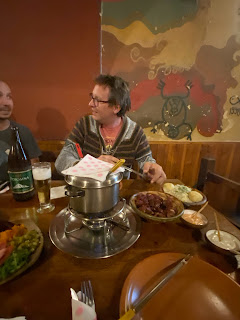
MMM...meat fondue!
November 17th – Dog gone it.
Today started with us taking Rupert to a vet.
He has not been to one since we left Colombia
because the importation rules for a dog to most countries in South America are
rarely enforced.
Chile is the exception.
We do always have the documentation required
to enter any country with the dog, we just don’t update is as often as we
should because no one ever asks.
Just so
we’re clear, we’re not breaking the law, the law is just not being enforced at
the borders we have chosen to cross…maybe it’s a coincidence?
So, here’s the long of the short; to get Rupert into Chile
he needs a vet certificate stating he has had an internal and external antiparasitic
treatment, he is treated for rabies and that he is in good health. Of course, this is when he has a minor skin
infection. All went well at the vet and
after an hour of paperwork and examination we got a health certificate. Rupert
even getting medication for his dermatitis.
With this health certificate we can then get the official
document from the Bolivian Agricultural office (SENASAG) which will allow us to
cross into Chile.
With one of the big tasks complete we were finally able to
properly wandering around Potosi. We had
originally tried to organize a mine tour for tomorrow, the must do thing while
in Potosi, but as it is Saturday tomorrow there would be no one working. Since we had been enjoying Potosi it seem
like a good decision to wait until Monday to do this tour.
With Potosi being a working class town there were many shoe
repair shops, and since her hiking boots had a hole in the side from falling
while hiking in Calle de Cocora, Colombia it was time to get them fixed. For about $6 cad both her boots would be put
back together and hopefully will be as good as new.
After leaving Rupert in the van we explored the Cathedral of
Saint Francis famous of its crypts and rooftop view point. The tour was all in Spanish but Paul did his
best to translate as much as he understood so Kendra could understand. The crypt in the church is now empty but we
saw aspects of the traditional Franciscan brother burial rituals and a few
human bones.
The view from the rooftop
was amazing as it overlooked the entire city of Potosi with Cerro Rico in the
background.
After all the exploring it
was time for the traditional Potosi soup called K’alaphuraka. It is a soup that
is served boiling hot due to the addition of a hot lava stone. This causes the soup to boil and is a unique
experience.
 |
| It's like "stone soup" |
November 18th - Haunting Hot Springs
Since we have a whole weekend until the office for Rupert’s
paperwork opens Paul decided to venture out of Potosi. Tarapaya is an area just north of Potosi
known for hot springs and thermal baths.
When we arrived at our first stop Ojo del Inca, we were a bit confused
as it seemed like this natural hot pool located in an ancient volcano was
closed.

After a bit of exploring an old woman appeared out of no
where to inform us that the site was indeed closed. The old woman was willing to show us around
and even said we could swim in the thermal lake if we wanted but then gave us a
brief history about the pools. In 2018 at least 3 people died in the thermal
waters of this lake. This continued year
after year with people disappearing in the lake then their body appears back in
the lake 24 hours or so later. She then
continued saying that the police are still investigating a body that was
recently dumped into the thermal lake we could not walk around the entire lake
back as someone had died in the last 24 hours and they suspected the body will
remerge in the next little bit.
Something about the prospect of a dead body randomly appear while we
were swimming convinced us not to swim.
No one knows how deep this volcanic lake is or the caverns it holds, but
it definitely has some bodies.

Next thing we knew there were two other Bolivian families
coming and her demeanor instantly changed to frustration as the Bolivian
families were in no mood for anyone to tell them what they couldn’t do.
After that chilling experience at the natural thermal
bath/lake we headed into the town of Miraflores to check out the established thermal
baths. These baths are pools the size of
most in any recreation centre in Canada and have hot water pumping from the
thermal source . For about $2 cad we figured we would check them out. It was a Saturday so the pools were all
busier than usual but we still enjoyed ourselves.
Interestingly the place we chose had signage stating that
you must shower with shampoo and soap BEFORE entering the pool. Kendra thought in Canada we shower to rinse
off any soap and laundry residue to keep the water clean, but here you must
clean your body first to keep the water clean…an interesting cultural learning
moment.
After the hot spring experience, we decided it was time to
find a campsite. Since there are no official campsites in the area we pulled
into the canyon close by and found a spot hidden from the road where we could
enjoy the canyon views and look out at some old ruins.
November 19th - Back to Potosi
We woke up in a beautiful canyon, after enjoy the sites and
a delicious breakfast we returned to Potosi so we could get our final errands
done.
First we needed gas where the nearest station refused to
sell us gas. He informed us a station 30 minutes up the road would have gas for
foreigners, but that was 30 minutes in the wrong direction, plus we still had
half a tank. We then tried a station in Potosi and we were successful. We
thought we would have luck because they had the foreigner price posted along
with the phone numbers to phone or text when you have a problem with a gas
station, like them not selling to foreigners.
We returned to our parking lot campsite that we had stayed at before and
wandered the city. We looked for more
soup with the volcanic stone in it but couldn’t find anywhere open. We went to an actual supermarket and picked
up a few things for a pizza dinner. We
even bought some Singani (Bolivian version of Pisco) and made our own Bolivian
version of Pisco Sours, which were very tasty.
We had some overlanding neighbours who are travelling South
to North so we talked with them about recommendations before hitting the hay
for a busy day tomorrow.
 |
| Pizza on the stovetop. We will miss olives from the market. |
November 20th - Drinking with Miners
 |
| Dynamite and Alcohol...what could go wrong? |
 |
| Wilson, our guide |
One of the must do things in Potosi is a mine tour and today
was our day! Our tour guide and driver ended up being late to pick us up, which
they profusely apologized but they could not understand why traffic was so bad
today (we did eventually find out why later). Outside of our camping
place/parking lot the gas station was lined up for at least 3 or 4 city blocks
and was always growing longer and longer.
It was amazing seeing vehicles trying to cut in line as we waited for
our guide.
Eventually Wilson (our guide)
showed up and a few minutes later our tour bus did as well.
 Wilson took us to the miner’s market where many miners will
eat breakfast and buy the explosives and tools they need to extract
metals. We learned that many miners will
use 50 coca leaves to keep track of how long they have been working for. When the cocoa loses its flavour, they take a
break. This break often consists of
stopping for just a few minutes to an hour to drink and replenish their coca
leaves within their mouth before continuing there work. We picked up some juice
and coca leaves to give to some miners as gift for allowing us into the area
they are working and when we came upon miner will gladly shared our gifts. Many
metals are mined in Cerro Rico, the rich mountain such as silver, zinc, and
lead.
Wilson took us to the miner’s market where many miners will
eat breakfast and buy the explosives and tools they need to extract
metals. We learned that many miners will
use 50 coca leaves to keep track of how long they have been working for. When the cocoa loses its flavour, they take a
break. This break often consists of
stopping for just a few minutes to an hour to drink and replenish their coca
leaves within their mouth before continuing there work. We picked up some juice
and coca leaves to give to some miners as gift for allowing us into the area
they are working and when we came upon miner will gladly shared our gifts. Many
metals are mined in Cerro Rico, the rich mountain such as silver, zinc, and
lead.
At the entrance of the actual mine we donned our miner
clothes, basically polyester pants and jacket because it is easy to clean and
doesn’t use a lot of water, and our helmets and head lamps. We ended up walking a little further than
usual due to the traffic but we found a mine we could enter. Many miners are superstitious and women are
not allowed in some mines, so if you do a men’s only tour you may see different
things.

We finally arrived at the entrance to the mine and realized
we would not be good miners. In this
particular mine the miners would use wheelbarrows to move the minerals they
extracted out of the mine. There was barely room for a wheelbarrow to pass us
but the men were hustling. We made sure to hit our helmets on the low ceiling
multiple times, even when we were told to duck down. The working conditions in these mines made us
think of back in the olden days where workers would use pickaxes and hammers
and chisels to work. The miners who have
made money can rent or buy pneumatic tools, but some miners still use hand
tools. There were many paths leading up and down and to the sides from where we
were walking. It is easy to get lost in these tunnels. Wilson told us that the best tool to have for
mining here is Good Luck. There is no
guarantee you will get rich or that you will find anything.

The mines in Cerro Rico are part of a cooperative, and while
that sounds pleasant our guide assured us that it is not all about cooperation,
it is every man for himself; some will get rich and others will still be
working forever, or until the age of 46-50 when the average miner dies.
In the cooperative you must work for 3 years
under someone who is willing to hire you and pay your wage. If you have proven
yourself to be hard working then you will be given the opportunity to buy your
own membership into the cooperative.
If
you are lucky other may want to work for you under the cooperative where you
will pay their wages but get a percentage of anything they find. Interestingly
some miners are able to skip the three year process and inherit the mine areas
that their fathers mined.

 We met a few miners working and taking breaks or refilling
their cheeks with coca leaves. Many
start working when they are 16 or some even younger. Many of the miners spoke Quechua and believe
in Pachamama, which is similar to mother earth.
If you give to Pachamama she will give to you. The alcohol that the
miners drink is 96% and made from cane sugar. It is smoother than you’d expect
but would not be our first choice for alcohol. Its is a first choice for miners
because it is cheap and you don’t need a lot to get drunk. When
giving anything to Pachamama it must be done in even numbers. If sacrificing a llama,
you must do 2 or 4, when pouring drinks to the ground it must be an even
number. Miners do not mix their alcohol with anything because they believe that
mixing the alcohol makes it impure and by drinking mixed alcohol they will get
impure minerals. Mining in Bolivia is a religion filled with superstition and
strong beliefs which was highlighted when we sat around the miner’s deity
drinking pure alcohol with miners.
We met a few miners working and taking breaks or refilling
their cheeks with coca leaves. Many
start working when they are 16 or some even younger. Many of the miners spoke Quechua and believe
in Pachamama, which is similar to mother earth.
If you give to Pachamama she will give to you. The alcohol that the
miners drink is 96% and made from cane sugar. It is smoother than you’d expect
but would not be our first choice for alcohol. Its is a first choice for miners
because it is cheap and you don’t need a lot to get drunk. When
giving anything to Pachamama it must be done in even numbers. If sacrificing a llama,
you must do 2 or 4, when pouring drinks to the ground it must be an even
number. Miners do not mix their alcohol with anything because they believe that
mixing the alcohol makes it impure and by drinking mixed alcohol they will get
impure minerals. Mining in Bolivia is a religion filled with superstition and
strong beliefs which was highlighted when we sat around the miner’s deity
drinking pure alcohol with miners.
 |
Miner's restocking their mouths with Coca Leaves.
|
 Once we finished touring the mine we went to see how they
grind the rocks to extract the precious metals.
The silver oxide we were shown at the end had only about 5% silver in it
and it would be exported to a different country to get the silver out. Once the
tour was over we made our way back to the van getting dropped off 5 blocks away
due to traffic.
Once we finished touring the mine we went to see how they
grind the rocks to extract the precious metals.
The silver oxide we were shown at the end had only about 5% silver in it
and it would be exported to a different country to get the silver out. Once the
tour was over we made our way back to the van getting dropped off 5 blocks away
due to traffic.
Luckily when we got back to the van we were able to make our
way around the line up at the gas station and make our way to the SENASAG
office. After an hour Paul had returned
with the export/import paperwork for Chile and had learned the reason why the
traffic was so bad. Supposedly the Bolivian Government did not pay its fuel
bill. The Bolivian government buys in
bulk then subsidizes it for its citizens.
By no paying for the gas people were concerned the fuel would run out so
people started to panic buy. We were so
thankful we purchased fuel yesterday.
Once we were out of the city of Potosi making our way
towards Uyuni it seemed like other towns may not have heard to this development
with the government and gas because there were not any lines at the gas
stations like we saw in Potosi.
We even
filled up our tank in Uyuni and the line was normal, so no panic here.
Before settling in for the night we purchased some bread and
meat for dinner. Paul thought he was
buying beef, but he got llama instead, so we will had some llama steaks tonight
for dinner while we camped beside a train cemetery. The trains and their engines were all used in
the mining heyday, but since that heyday is over the trains were left in the
desert to spend their final days.


.jpg)


.jpg)


