Historically El Salvador has been a country that has had issues with gangs and safety; however the country is beaming with optimism and it is contagious. Although the actions of their President are controversial (imprisoning over 60,000 people) most citizen's couldn't be happier and are so excited to be able to safely see their own country and be able to show their country off to visitors. During our time in El Salvador we fell in love with this small central american nation and it's people. So often we received a wave or a friendly honk with a thumbs up. Any issue or question was quickly answered with people routinely dropping everything to help us or show us how to get somewhere. We do wonder what will happen in a few years when people start being released, but in the meantime we would recommend everyone to start looking at buying flights and exploring.
April 6th – Quiet towns
We couldn’t leave our campground without going back and
enjoying the hot springs for another few hours.
We couldn’t believe how beautiful and relaxing the hot springs
were. Alas all good things have to come
to an end so we packed up the vehicle to explore the western area of the Ruta
de las Floras, a mountain road known for flowers.
The route started at the community of Ahuachapan where we
saw the source of the hot springs for the area, a location known as Los Ausoles
which almost looked like a micro Yellowstone.
Next we explored the center of Ahuachapan which surprisingly was very
quiet. We assumed for Santa Semana
people would be in the streets but it seems that the people of El Salvador
choose certain communities to celebrate in, and this was not one of them. Paul
tried to get a smoothie at 11:30am but was told he was too early.
We had read of a cute mountain town close to Ahuachapan
called Tacuba so we headed there next only to find another quiet town. There were some beautiful ruins of an old
church but they were all locked up meaning it was impossible for us to truly
appreciate them.

Our next stop was the community of Concepcion de Ataco which
was the opposite of quiet. It seemed
that everyone from the surrounding
communities had come here to celebrate the Holy Thursday portion of Santa Semana. After finding parking we wandered the street,
had a cold coffee and admired some other floral carpets created on the roads.
We even watched the Santa Semana procession and a funeral procession face off
in the street, someone somewhere is having a laugh about that. Sadly, it was getting late and we had to find
camping, which we decided would be a volcano crater.
We drove up some ridiculously steep roads following some
side by sides and quads/4-wheelers but us and our van eventually made it to the
crater; a spot we could camp for $5! The
place was very busy with locals relaxing in the cooler weather, having fires,
taking hikes and rowing boats but by 7pm we had the place practically to
ourselves for a nice quiet and cool night.
April 7th – EXTREME GAMES
Yesterday, as we drove to the campsite we had noticed a very
busy place with a labyrinth. We enjoy
doing labyrinths but hadn’t done one in years so we decided to backtrack a bit
to test our navigation skills. With it
being Good Friday the place was already getting busy by the time we pulled into
the parking lot, but we knew, based on the traffic we saw yesterday it was
going to get way busier so we purchased our tickets and headed to the entrance
of the maze.

The maze was tough and way larger than anything we had
experienced before, we actually started to feel anxious about finding our way
to the center and back. According to
online, anyone who knows the route can get from the entrance to the middle and
back in less than 15 minutes, well it took us an hour and a half. The amount of people also doing the maze actually
made it more fun as you would see the same people again and again and greet
them with a laugh, both knowing that you had been turned around. Kendra also
didn’t do the proper research for this maze and thought there was an exit
different from the entrance. Once we
rang the bell to announce that we made it to the centre we did a lap around the
entire maze looking for the exit. Just
as we were about to use the emergency exit since we had seen many others use
it, we were back at the entrance where the ticket checker made sure we rang the
bell, or else we couldn’t leave the maze.
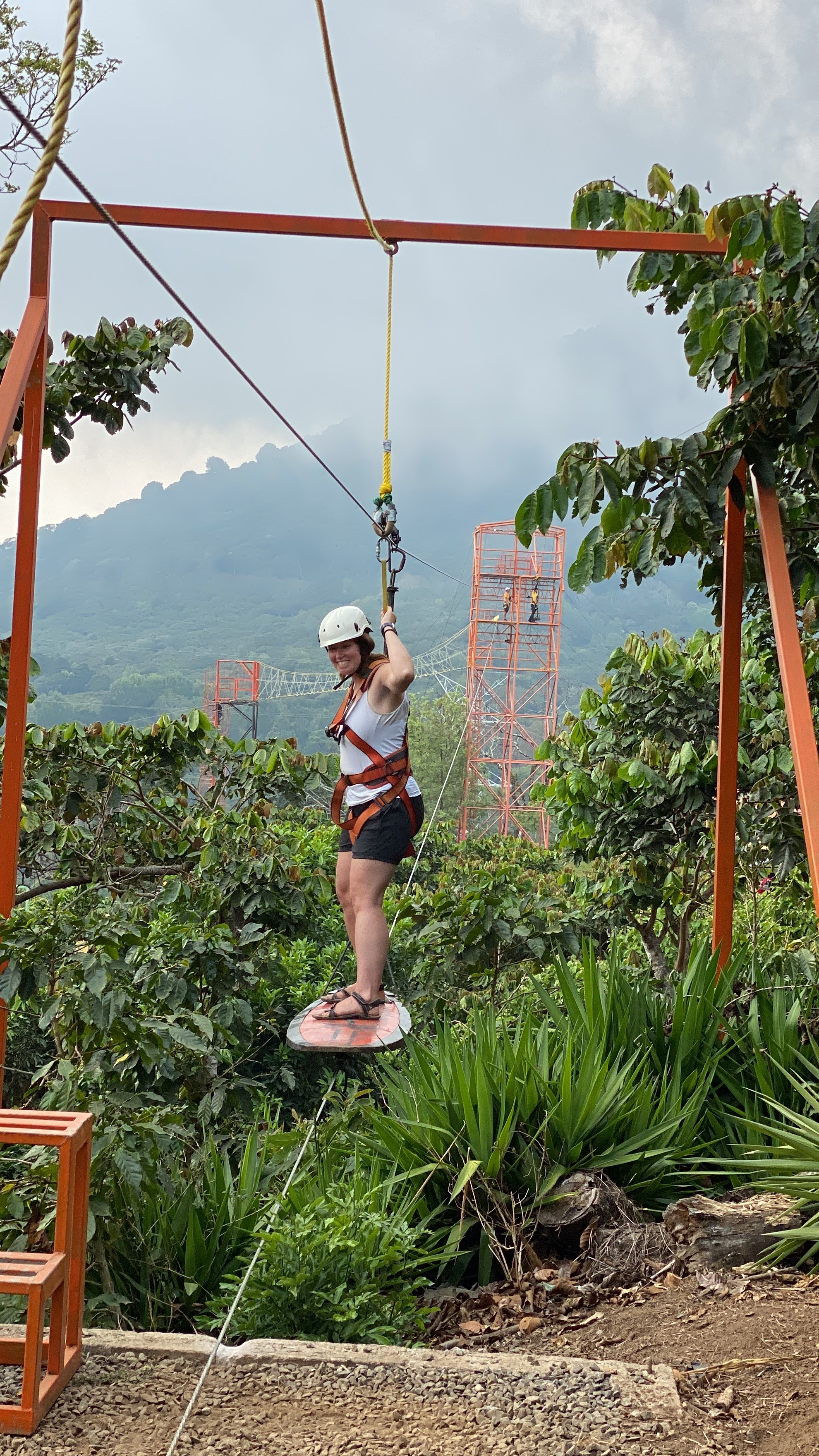
This adventure park had other things to do that they
classify as “EXTREME GAMES”, which in general all involve zip lines or swinging
over the edge. The two “games” we
couldn’t stop watching people do were riding a bicycle over a wire and surfing
down a zip line. Paul choose to ride the
bicycle and Kendra decided to surf down the zip line. We purchased our tickets, waited in line and
before we knew it we were far above the ground.
Paul was first on the bike, he jumped on and the guy told him to bike
slow, which Paul thought he did, until all of a sudden he had passed everyone
else and had no real way to slow down.
The speed wasn’t his concern, rather the slight wobble from the wind that
kept him concerned about the tire jumping off the wire. He survived. Kendra was far less scared during her ‘game’,
she jumped on the surf board with confidence and surfed her way down to ground
level.


We drove to the community of Juayua in the heart of the Ruta
de las floras where there were more flower carpets for Santa Semena and a large
food market. It was time for
lunch/dinner (3:00pm) so for less then $10 we ate delicious “street food” that
resembled something you’d get at a good restaurant. Each vendor had their food on display so we
picked what looked good. We both choose a food stall that had food we wanted,
ordered and they brought it to our table in the middle of the park. Kendra had
chicken stuffed with cheese and tortillas and rice and Paul had a seafood feast
with shrimp and fish fillets. A random
guy even came by selling beer. It was
the perfect way to celebrate surviving EXTREME GAMES.
Just outside of Juayua is a relatively famous overlanding
campsite, it’s a free spot in a farmers field.
We arrived met the farmer and his family and set up for the night beside
a few other overlanders. We spent the
evening watching the animals and playing some games.
April 8th – Surrounded by Volcanos
We woke up and met our overlanding neighbours who all had
different goals and ambitions. Some were going to live in Belize, others were
going to continue traveling, and one family was going to teach in El Salvador
and open a French café/restaurant. Next we returned to Juayua; we had missed
the procession for today but the market was busy and we wanted to purchase some
coffee to drink and coffee grounds for future mornings as this area is known
for its coffee. I don’t know how we will
survive Canada again since after going
to southern Mexico we have been spoiled with amazing coffees for relatively
cheep prices. Even the coffee we make in
the morning with purchased coffee grounds from local producers have been out of
this world. The only thing missing from our morning coffee is dairy/creamer,
but the coffee still tastes amazing even with coffeemate powder in it.

El Salvador has a negative history with gang violence and
murders but their current President went through the entire country and has
purportedly arrested 60,000 people and threw them into jails that could only
accommodate 10,000 people. In general
the people of El Salvador love their president but many dislike him for putting
their loved ones into prisons with little to no trials or due process. There are many who believe their loved one
was innocent. The president disagrees
with these allegations stating that anyone put into jail either had known ties
to gangs or had gang tattoos, determined when the police went into communities
and searched the bodies of young men. We often wonder what will happen when
people start being released as our understanding of the history of incarceration
without rehabilitation is typically a recipe for worse future crime, but right
now places that historically a tourist could not go are welcoming and safe.
Once such place is Sonsonate, the last community on the Ruta de las Floras
which was the murder capital of El Salvador.
This community still bares a lot of emotional scars from its past so we
didn’t stay too long, but it definitely felt different then the other
communities in El Salvador we had visited; a bit more grungy and real, but
people were still friendly and curious and talked with us about Rupert.

Our final stop for the day was Cerro Verde National
Park. This national park historically
was controlled by gangs with the police offering armed escort (for a small
donation) for anyone wanting to hike to any of the three volcanos within the
park. On our camping app, iOverlander,
there are numerous warnings about robberies and armed violence at viewpoints
and on roadways, but this was all before the mass incarceration of people. Salvadorians are exploring their own country
for the first time in years and seeing Cerro Verde is one of those spots that
they wanted to go to. We couldn’t even
get to the parking lot it was so busy! They had the equivalent of the Ministry
of Tourism on the road to Cerro Verde explaining to people that the parking lot
was full, so you didn’t have to pay to park if you were on the road, so we
parked on the road and hiked up into the park. (NOTE: it was extremely busy due
to Easter/Santa Semana, not because it was finally safe, its been relatively
safe for a couple years now).

There are three volcanos viewable in Cerro Verde National
Park, Cerro Verde, which isn’t that impressive and has been dominant for
hundreds of years. Santa Ana, which you can, and we will, hike up, it is quasi
dormant, it hasn’t erupted in about 18 years or so and last time it did it
caused the evacuation of a community.
The final one is called Izalco which is mesmerizing to look at as steam
still comes out the top and it looks like a stereotypical volcano and has
caused monumental changes to the landscape of El Salvador with a peninsula 50
kilometer away made completely from volcanic rock from this volcano.
We viewed all the viewpoints in Cerro Verde National Park
and even did a small circular hike with a guide, but by 3pm the clouds were
rolling in and the views were disappearing so we decided to camp in a hotel
parking lot where many people hire a guide to take them up Santa Ana
Volcano.
We had a pretty low key evening of movies in the van and
beers and the BEST Michelada (passionfruit and tajin flavoured) at the hotel
restaurant, excited to hike up Santa Ana in the morning.
April 9th – Hiking up Santa Ana
 We woke up at 6:30 am
which is the earliest time you can hike up the volcano and learned there are
two options to hike up. The first option
is to spend $35 usd for a private group; the second option is $3 usd per person
for a public group that will leave whenever the minimum amount of people is
reached (15). We originally thought to
do option 2 but a couple from the Cayman Islands was going to do Option 1
regardless and wanted to make sure they were on top of the Volcano before the
large groups of people start hiking. We
decided to also do the first option because it cut both our costs in half as we
would share the group cost and we could leave immediately.
We woke up at 6:30 am
which is the earliest time you can hike up the volcano and learned there are
two options to hike up. The first option
is to spend $35 usd for a private group; the second option is $3 usd per person
for a public group that will leave whenever the minimum amount of people is
reached (15). We originally thought to
do option 2 but a couple from the Cayman Islands was going to do Option 1
regardless and wanted to make sure they were on top of the Volcano before the
large groups of people start hiking. We
decided to also do the first option because it cut both our costs in half as we
would share the group cost and we could leave immediately.
The hike was beautiful with sweeping views of Lago de
Coatepeque and the other Volcanos. We
didn’t know what to expect when we arrived to the top of Santa Ana Volcano but
were happy with what we found. It was a
barren landscape up to the crater. The
crater itself was dynamic with multicolour lines all the way down to the bottom
which contained boiling water that was a beautiful blue colour. We could have stayed here for hours but the
wind was wild and would occasionally pelt us with rocks and sand to remind us
who was in charge.

As some may know Bitcoin is an official currency of El
Salvador and pretty much all businesses accept it (Unfortunately Paul only has
Ethereum and alt coins so we never attempted to pay with cryptocurrency). Samuel, the guy from the Cayman Islands who
is originally from Canada said it was a must do to tip his guide on top of a
volcano in bitcoin and so we got to watch this crazy interaction where bitcoin,
a legal tender, was transferred from one digital wallet to another on top of a
volcano. We are glad we checked that item off of our bucket list, even though
it had only been on our bucket list for about an hour.

During the course of our hike down Paul tried to practice
his Spanish with the guide, which went pretty well, having conversations about
our trip, El Salvador and of course the weather. Paul did have an awkward incident with some
Police as we hike down when they said to him “Diez Fruitas” at least that is
what Paul heard, where he instinctually said “No Tengo Fruitas” or I have no
fruit and opened up his bag. Turns out
what they has actually said was enjoy your trip, meaning Paul’s response made
no sense, especially since there were apples in his backpack… The Police burst into laughter and everyone
around us had a good chuckle too.

Samuel and Jo were the interesting couple we shared the
hike/guide with, both living on the Cayman Islands, but neither were citizen,
Samuel is Canadian and Jo is English, they just applied for jobs, and after
successfully interviewing were offered jobs with the government of the Cayman
Islands. It really made us think maybe
we should think about applying for jobs in the Cayman Islands as we are getting
used to warm weather and being so close to the ocean.
After saying goodbye to our new friends we drove Lago
Coatepeque, the location where the rich El Salvadorians own property. Unfortunately, most of the lake is privately
owned or the location of restaurants/nightclubs makes a quiet day on the lake a
challenge. Samuel and Jo had been to the
lake and found it underwhelming, we took their advice and avoided the touristy
areas but there was one cooperative that allowed camping for $5 in a rural part
of the lake. We drove over and set up
camp, taking a swim in the lake to wash away our sweat and then spent the rest
of the day relaxing by the beach and looking out to the volcano we had just
climbed, which just happened the highest volcano in El Salvador.
April 10th – Pupusas with a view
We had hoped to go to the Pompaii of Central America, Joya
de Ceren, but after driving from the lake to the Archaeological Site we learned
it was closed on Mondays. Usually we
would have googled when it was open however we ran out of cell phone data and
learned we could not recharge our Guatamala cell account in El Salvador. We thought we could pay by credit card, but
their app only accepted Guatemalan credit cards.
Joya de Ceren was a small Mayan village covered in volcanic
ash and perfectly preserved. It sounded
interesting but unfortunately due to our timeline we had to skip it.
Our next stop was groceries in the community of
Quezaltepeque, Kendra successfully navigated us to a grocery story without
internet, but the grocery store was in the middle of town near a huge market,
the roads were wildly busy and the drive was an adventure. The benefit of a grocery store so close to
the market is while Kendra was waiting in line to pay for our groceries Paul
went to the market and purchased eggs and cheese at a fraction of a cost of
those in the grocery store. Paul also
had to run around the grocery store once we realized that they weigh the
vegetables and put a price on them in the produce department, not at the
cashier. This system works extremely
well and we are surprised we haven’t seen it in any other country.

We decided to go to another national park just south of
Guezaltepeque, Boqueron National Park.
This National Park is probably the smallest one we have ever done which
means that very quickly we arrived at the main view point overlooking a volcano
crater, we took a few photos, but spent most of our time reminiscing about
Cerro Verde. We had been told that there
was a good restaurant with a view of San Salvador near the national park, so we
decided to try the national dish of El Salvador, Pupusas. They are tortillas filled with cheese and
other ingredients eaten with fermented coleslaw and hot sauce on top. You are supposed to eat it with your hands
and not eat it like a taco, but we really struggled to eat it correctly. Regardless, it was delicious and the views of
San Salvador complimented the meal perfectly.

We decided to go into San Salvador as there was a microbrewery
close to where we would be camping and we wanted to get a new SIM card so we
would have data on our phone again.
After our errands we tried to go to a camping area within an eco park
but the road was in very bad shape so we eventually abandoned our plan and
camped in the parking lot of the eco park.
April 11th – Back to the heat
Our first stop today was to visit San Salvador. This city was also previously known as a
dangerous place due to gangs but has begun to change since the arrests. After getting caught in an infitinite loop of one way roads on the opposite side of
the highway we wanted to be on, Paul informed Kendra that there is a different
navigation app that Salvadorians use, but he couldn’t remember the name of
it. We eventually found the beloved
retorno and ended up where we needed to be, a parking lot on the edge of the
historical central district. We saw the cathedral and national theatre and met
some very friendly people wondering where we were from and checking in to see
where we had been in El Salvador and making sure we were enjoying the country.
After wandering we went shopping at the market.

One thing that we may not have shared before is that we have
10 +/- days of clothes each. We have had to dispose of some clothes along the
way, have bought new clothes and touristy shirts, and had some clothes go
missing when we have gotten laundry done (we also still have a random pair of
socks we use for rags and did end up with a new pair of sweatpants in Mexico). Kendra has regularly lost 1 pair of underwear
the past few times we had laundry done.
Of course it’s her favourite pairs, which are also the expensive quick
dry, smooth material, hiking ones. So with her underwear count below 10, she
noticed a lot of booths selling underwear and was able to buy two new pairs in
the market (for those wondering it was $5 for 2 pairs)! We also bought some
grapes, avocados, and green mangoes- an El Salvadorian specialty at the
market. As we were walking back to the
care we picked up one last “essential” item for the van, a pop up reflective
pylon. We have heard stories of people
having trouble at some borders or when interacting with police because they
don’t have a fire extinguisher or reflective pylon to put out in case of
emergency, so we now have our pylon and we hope we don’t need to use it.

Next we decided to drive to Suchitoto because we had read
that it is a beautiful colonial town on a lake.
We didn’t realize how hot Suchitoto would be as when we arrived it was
close to 40 degrees. The town was very
quiet and our best guess as to why was today is the first day after Santa Semana
and Suchitoto is where many people go to experience Santa Semana. We think that the town was having an official
day of rest from all the activities. It
was a colourful community but no different from other colonial cities we had
been to in Central America. We had hoped
to people watch in the town square but only found a touristy restaurant with
subpar food; however, their beer was very cold and delicious.
We ended up meeting a family originally from England but the
parents had moved to Georgia and the daughter her partner had moved from Malawi
to El Salvador to teach at an English school.
It was nice chatting with them and it made the decision to go to a
restaurant with subpar food and food decision for us. We didn’t’ end up
catching their names, but we are sure they will read this and say to themselves
”thank goodness they didn’t mention our dogs”.
They had two terriers that were curious about Rupert and tried to get
his attention, but Rupert’s deafness and daftness meant that he slept through
this interaction; he was too busy focussing on getting acclimatized to the heat
that he didn’t have time to make friends.
 After leaving the restaurant and a bit more exploring we
headed to a campground near the Suchitoto Lake where we tried to avoid the heat
by distracting ourselves with games in the shade of our awning.
After leaving the restaurant and a bit more exploring we
headed to a campground near the Suchitoto Lake where we tried to avoid the heat
by distracting ourselves with games in the shade of our awning.
Our evening was spent visiting and sharing beer with a
German couple who rode their motorcycles from Ushuaia Argentina all the way
north to their current location in Suchitoto.
We swapped stories and got a new appreciation for the roads ahead and
what it takes to do this trip on a motorcycle.
Before we knew it, it was almost midnight and time to sleep.
April 12th - Doing our own Laundry again
By 8am it was sweltering hot in Suchitoto so we decided to pack up the van and do a bit more exploring of the area. We said goodbye to our new German friends, Thom and Andrea-and swapped old SIM cards and currencies that we had for each other’s future countries and made our way to a Basalt Column waterfall. Unfortunately, it is almost the end of the Dry season meaning everything is very dry and there was no water in the waterfall. The views of the lake and the Basalt Columns was still worth the price of admission as we spent our morning sweating out the beer consumed yesterday.
We returned to a much busier Suchitoto and ran into the
family from England again. After a quick
hello we had lunch at a Pupuseria and grabbed some ice cream for the drive.
We were in desperate need to do laundry and found and
laundromat in a small community called Berlin.
We expected to drop our laundry off and pick it up tomorrow as we had
done since leaving the US, but this was a laundromat that we would have seen
anywhere in the US or Canada meaning we had to do our own laundry. I don’t know why this seemed to be a
stressful endeavour for us, but it was and with some help from the woman who
owned the laundromat and a lady visiting her family from LA, we cleaned, dried
and folded our own clothes. Nothing went missing this time!
Our final stop for the day was another volcanic crater
called Laguna de Alegria a peaceful place with emerald water surrounded by the
rim of a volcano. It was cool in
temperature and generally a cool place to be.
Being in nature camping beside a lake really made us want to relax for a
day, but alas we applied to be in Nicaragua in one weeks time, and there was
still lots to see in El Salvador and Honduras.
April 13th – Preparations for future borders
We debated for hours whether or not to stay at the lake, but
in the end decided to leave. We were in
no rush because we paid the camping fee plus the next day’s day use fee for the
park, so Paul spent the morning writing the blog lakeside with a couple
delicious cups of El Salvadorian coffee.
It never feels like we have slow starts to the day, normally the start
of our days always consist of waking up, packing up, cooking breakfast then
immediately leaving, but we could get used to these slower starts.

We also read about a cenote en route to San Miguel in the
community of Moncagua so decided to spend the late morning/early afternoon
relaxing in the water. When we first
arrived at the “cenote” we debated turning around as it appeared to just be an
outdoor swimming pool but decided to spend the $2 and check it out, besides it
was dog friendly! Well, it definitely
was a cenote but they had expanded it so more people could enjoy it giving some
areas a outdoor swimming pool feel. We
still enjoyed it immensely, well Paul did.
There were tonnes of fish in the pools who loved to eat the dead skin
off your body and Kendra was having none of that. Paul was a little unsure after the nipple
biting incident in Belize but felt better after a few minutes without feeling
pain or seeing his own blood.

Before we knew it the temperature outside was nearing the
mid 30’s so it was time to go to San Miguel and get some errands done. We had made a decision to leave El Salvador
on Sunday (2 days from now) so we needed to get our paperwork in order,
specifically a couple vet certificates for Rupert (one for Honduras and one for
Nicaragua) and various photocopies required for leaving and entering
countries. We thought we had enough for
the entirety of Central America, but we were wrong. We made copies for entering
countries, but it seems we’ve needed copies of drivers licenses and passports
to leave with our van. Borders officials seem to want to keep a lot of mementos
of us and our journey, and we are not going to argue with any official.
After sitting in a lot of traffic we finally found a vet
that was open and was willing to see Rupert right away. After some discussion and a good examination
Rupert had his clean bill of health. We
looked at google and were surprised to see that a place that does photocopies
was only a couple blocks aways meaning within short order we had all our
preparations done for future borders (well almost, but I’ll get to that later).
To celebrate Kendra wanted to get some pupusas and for some
reason no restaurants in San Miguel near where we were located sold them meaning
we spent an hour wandering the hot streets of San Miguel in search of
food. Kendra was lucky that the pupusa
place she did find had the best Pupusa’s we had had in El Salvador; better yet
they were the cheapest. A full meal of pupusas
with smoothies cost just over $6!! (65 cents/pupusa x3/person, plus $1-$2 for
drinks).

It was still a few hours until sunset so we decided to drive
to the coast. We hadn’t seen the Pacific
Ocean since Mexico so we felt it was time to be near the water. The drive was uneventful but ended at a
campground 100 meters from the ocean. We
took our chairs to the water and just sat staring at the water (and
occasionally our phones or the iPad- we are currently watching El Chapo) until
it was too dark to see anything. Before going
to bed we did the final thing we needed to do to enter Honduras, our
Prechequeo. The Prechequeo is a document
that tells the government of Honduras all the questions the border guards
typically ask you and is required to be filled out before arriving at the
borders. We were told it must be filled
out 3 days before entrance to the country but we were undecided when we would
actually enter the country. Today we had
made that decisions and now we truly were done all our preparations!
April 14th – We got WIFI!!
Paul wanted a beach day!
He had a vision in his mind and he wanted to stop at nothing to find
it. He had been reminiscing about Baja
and camping right on the beach and wanted to recreate on of those days.
We drove down the coast as far as Punta Mango, known for
it’s black sand and volcanic rock beaches, but nothing was fitting the
bill. Either there was no view, or no
access to the water or it was a rocky beach.
After about an hour and a half of driving small roads where the minivan
had no business in driving he finally gave up and went to the beach that many
El Salvadorians say is their favourite, Playa Las Flores near El Cuco.
We had heard that there was camping available but it wasn’t
directly on the beach, we compromised.
We would camp away from the beach but would spend a lot of time at a
beachside restaurant/bar enjoying the view of the beach.
After a fair bit of time, we eventually decided to go to the
campground, set up camp then wander back to the ocean. Well, that was the plan.
We had been debating about having a hotel day for a long
time, mostly to have wifi and get caught up in the world and other tasks
(including updating this blog on the internet).
Well, this campground had amazing wifi.
Before we knew it we were updating everything, downloading Netflix, video
calling family, etc. We ended up going
to bed after midnight. It seemed it had
been too long since we had wifi and couldn’t seem to shut off our supply to the
internet and go to bed. A fun fact is that we hadn’t had wifi since San Pedro
on Lake Atitilan, and the wifi stopped working because the power was out, and
the time we had wifi before that was outside of Tikal, and again the power went
out at 8 pm and didn’t return before hotel check out time, so we had some
unfinished business when it came to uploading and posting things.
April 15th – Reminiscing about El Salvador
After another slow and hot (+32 at 9:30 am) start to the day
we left the beach towards La Union, a community known for its heat. It wasn’t really what we wanted but it was
the last community before Honduras and there was a volcano that you could drive
to the top of which gave you views of three different countries: El Salvador,
Honduras and Nicaragua.
During the drive to La Union (less than 50 kms set to take
over an hour), we couldn’t stop thinking about our time in this country. We have thoroughly enjoyed the sites and the
people. They are so genuine and willing
to help you. They are genuinely excited
to see tourists and want to strike up a conversation about what you have seen
and what you enjoyed. It was common for
us to drive and get a honk or two and a wave when people saw our license plate. It really made us feel special and that we
have accomplished something.

We are at the point in the trip that we are running into
people (or learning through Instagram) that people who had hoped to do the
Pan-American highway have decided the journey in their mind was not the one
their heart wanted and have stopped and turned around or are planning to turn
around. We often would talk about people
“only” going to Panama or “just” to Mexico.
But really these are massive accomplishments that really take you out of
your comfort zone. No matter how far
someone goes, it is an accomplishment; however, we still have our sights set on
south.
We picked up our groceries and some water from La Union and
headed up the volcano and a road where some people said high clearance and 4x4
is recommended and other said any vehicle can go up it. Well, we made it up but it was a difficult 6
kilometers. It was worth the drive, but
maybe just barely.
On top of the volcano was our viewpoint but due to pollution
and fog we could only see two countries.
We had a similar let down at our view point for sunset, the weather was
just not cooperating with us. We did
have another very positive experience with the El Salvadorian people
though. A man went out of his way to
take us to the Mirador for sunset and help Paul practice Spanish. We half assumed that he would want money for
helping us but after all the help he just wished us well and said he was glad
we enjoyed his country. We truly will
miss this country.


 It was cool to hike past all the old
infrastructure left behind. The hike
ended in a waterfall which wasn’t that dramatic because we are in the dry
season, but the hike was amazing so we didn’t feel too sad the ending was
anticlimactic. We also saw a cute and fluffy street dog on our way back to the
van that was so cute it distracted Kendra. Unfortunately this distraction meant
Kendra was not looking where she was walking and ended up stepping ON a snake!
Measuring close to 1.5 feet it was the largest snake she has ever stepped on
and hopefully she will never experience that again!
It was cool to hike past all the old
infrastructure left behind. The hike
ended in a waterfall which wasn’t that dramatic because we are in the dry
season, but the hike was amazing so we didn’t feel too sad the ending was
anticlimactic. We also saw a cute and fluffy street dog on our way back to the
van that was so cute it distracted Kendra. Unfortunately this distraction meant
Kendra was not looking where she was walking and ended up stepping ON a snake!
Measuring close to 1.5 feet it was the largest snake she has ever stepped on
and hopefully she will never experience that again!


 We were feeling pretty good about our time in Honduras and
decided to celebrate by returning to Tegucigalpa and checkout their local craft
beer scene. The bar we would go to was
in the “safe” part of the city so we battled the traffic once again to taste
some craft beer. It was wild how
different the areas of Tegucigalpa were.
The area we were in felt like a totally different city from what we had
experienced our first day, it was clean, modern and cosmopolitan with many young
professionals in suits driving nice cars.
If we had been dropped into this area we would have never guess we were
in Central America, let alone Honduras.
We were feeling pretty good about our time in Honduras and
decided to celebrate by returning to Tegucigalpa and checkout their local craft
beer scene. The bar we would go to was
in the “safe” part of the city so we battled the traffic once again to taste
some craft beer. It was wild how
different the areas of Tegucigalpa were.
The area we were in felt like a totally different city from what we had
experienced our first day, it was clean, modern and cosmopolitan with many young
professionals in suits driving nice cars.
If we had been dropped into this area we would have never guess we were
in Central America, let alone Honduras. We got to the campground and unsurprisingly we were the only
ones camping at it meaning we had a private pool and a little waterfall to
ourselves, which was the perfect place to enjoy the evening and our final night
in Honduras.
We got to the campground and unsurprisingly we were the only
ones camping at it meaning we had a private pool and a little waterfall to
ourselves, which was the perfect place to enjoy the evening and our final night
in Honduras.

 Part of the reason for our adventure in Honduras was to
avoid the two border day, leaving El Salvador and driving right to
Nicaragua. We had also heard horror
stories of the south western border between Honduras and Nicaragua with people
breaking down in tears or waiting around for 5 + hours to to bureaucratic
nonsense. We can say that we are very
happy we choose the Las Manos border.
The border was not busy and felt like a scavenger hunt where we went
from building to building (shipping container to shipping container that housed
different ministry offices) asking where to go and once finding the correct
building and completing a task asking where to go next. We heard that the other borders no one will
help you, but at this border the Nicaraguan officials were happy to point you
in the right direction, with one even leaving her post to make sure we found
the spot to do Rupert’s paperwork. It
was definitely not our easiest border but it only took us 2.5 hours to
get through.
Part of the reason for our adventure in Honduras was to
avoid the two border day, leaving El Salvador and driving right to
Nicaragua. We had also heard horror
stories of the south western border between Honduras and Nicaragua with people
breaking down in tears or waiting around for 5 + hours to to bureaucratic
nonsense. We can say that we are very
happy we choose the Las Manos border.
The border was not busy and felt like a scavenger hunt where we went
from building to building (shipping container to shipping container that housed
different ministry offices) asking where to go and once finding the correct
building and completing a task asking where to go next. We heard that the other borders no one will
help you, but at this border the Nicaraguan officials were happy to point you
in the right direction, with one even leaving her post to make sure we found
the spot to do Rupert’s paperwork. It
was definitely not our easiest border but it only took us 2.5 hours to
get through. Unlike El Salvador and Honduras we had to have a typical first
day in Nicaragua, our data had run out on our phone plan so we went to the
first real community south of the border, Ocotal for groceries, a new sim card
and cash. We had read there was a
campsite in Ocotal, we even wrote the address on all our official documents for
Nicaragua, but it turns out that it was just a restaurant.
Unlike El Salvador and Honduras we had to have a typical first
day in Nicaragua, our data had run out on our phone plan so we went to the
first real community south of the border, Ocotal for groceries, a new sim card
and cash. We had read there was a
campsite in Ocotal, we even wrote the address on all our official documents for
Nicaragua, but it turns out that it was just a restaurant. 
.jpg)